
You Have a Booking Database. But Do You Have a Customer Database?
Part 3 of 6
Most businesses accept last-minute gaps as part of the job.
A busy restaurant opens its booking system on Monday morning and sees hundreds of customer names from the previous week. A golf club can see every tee time, a salon has a diary full of appointments, and an attraction knows exactly how many tickets it sold. It is easy to look at all that information and conclude that the business has built a valuable customer database.
There is an important difference between knowing who made a booking and knowing who actually experienced your business. One records the transaction. The other gives you the opportunity to build a relationship with the people behind it.
That distinction is easily overlooked because booking systems are very good at doing the job they were designed to do. They organise reservations, appointments and availability. They record the details needed to manage a transaction and help businesses operate efficiently.
What they were never designed to do was identify everybody who walks through the door.
One Booking Doesn’t Always Mean One Customer
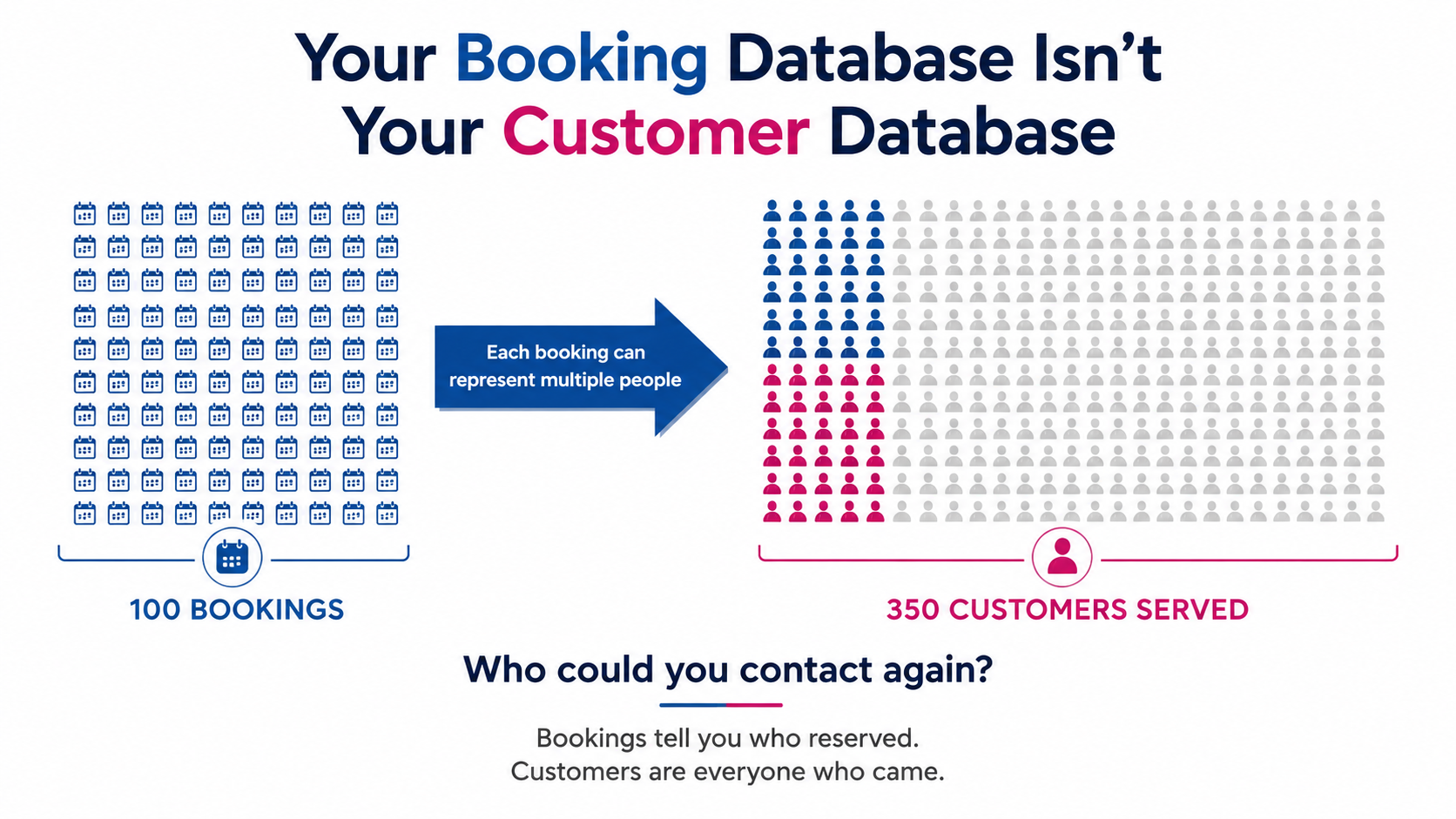
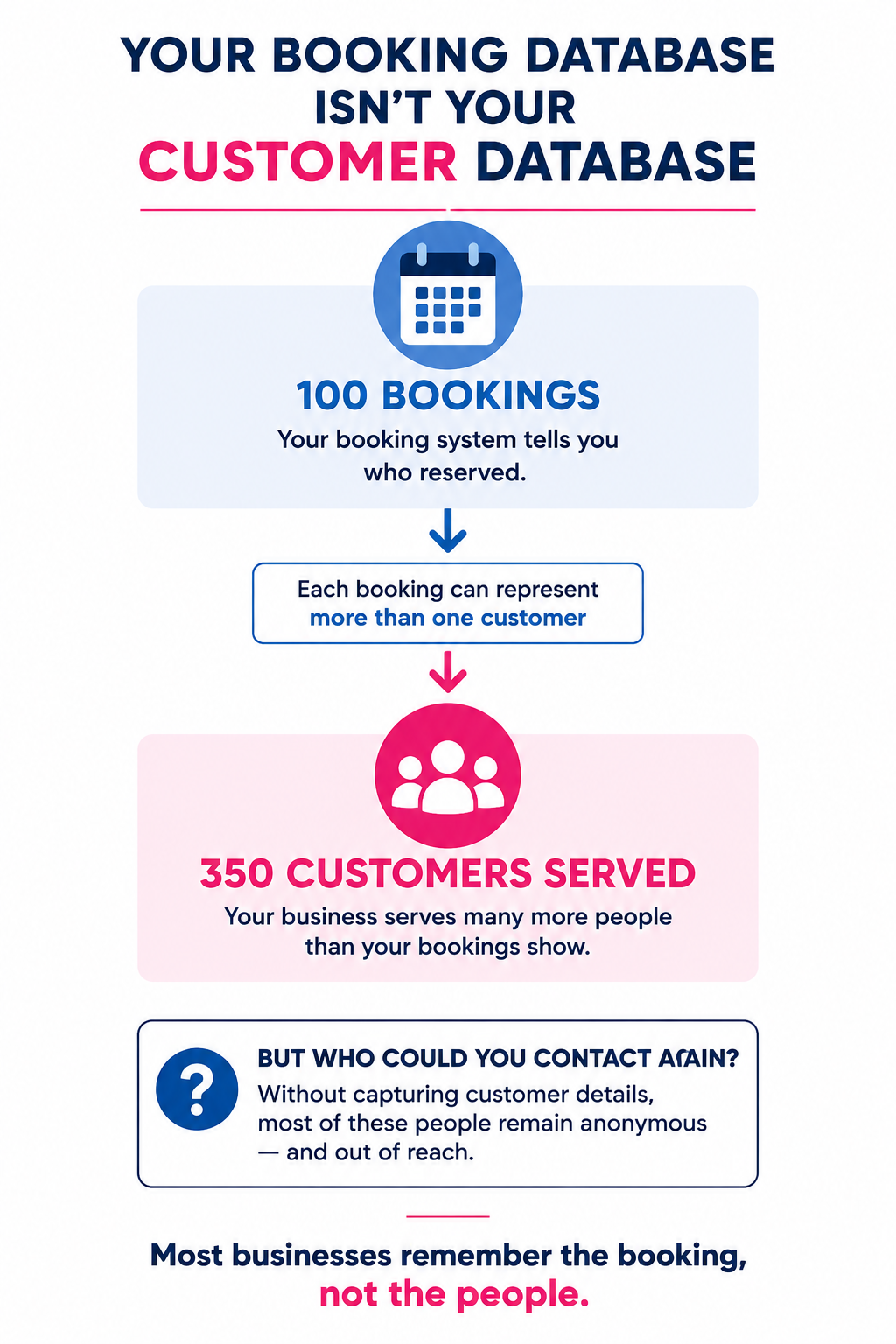
Consider a table booked for six people in a restaurant. The booking system may contain a name, mobile number and email address, which gives the impression that useful customer information has been captured. In reality, the restaurant has welcomed six customers while identifying just one of them.
The other five aren’t necessarily casual or unimportant visitors. One might live nearby and have discovered a new favourite restaurant. Another may be planning a birthday celebration. Someone else could be responsible for choosing the venue for the next company dinner. Each has experienced the restaurant first-hand, but unless they return and make a booking themselves, the business may never know who they are.
The same problem exists well beyond hospitality. A golfer books a tee time for four players. A parent buys admission for a family of five. One person books an escape room for a group of friends. A customer reserves an activity on behalf of colleagues.
The systems behind those businesses may record four perfectly successful transactions, but the number of actual customers could be considerably higher.
That creates a gap between the customers a business serves and the customers it can actually recognise.
They have a booking database.
The distinction may sound like semantics, but commercially it can be enormous.
Businesses have become extremely good at recording transactions. We know when someone booked, what they bought, how much they spent and sometimes how frequently the person named on the account has returned. Modern booking and payment systems provide extraordinary amounts of operational information.
But transactions and customers aren’t the same thing.
If four people play a round of golf together, four people have experienced the course. If six people share dinner, six people have formed an opinion about the restaurant. If two parents take three children to an attraction, the business has hosted a family of five even though its system may contain the details of only one adult.
The transaction tells you what happened, while the customer relationship tells you what might happen next. That is where much of the future value lies.
Someone who has already enjoyed your business doesn’t need to be persuaded that you exist. They know where you are, what you offer and what the experience feels like. If they had a good time, much of the work required to turn a stranger into a customer has already been done.
Yet if you don’t know who they are, you are effectively starting again every time you want to reach them.
When a Full Database Isn’t Really Full
This is why the size of a database can be misleading.
A restaurant might proudly have 10,000 names accumulated through its reservation system. That sounds substantial until you consider how many people may actually have eaten there while those bookings were being collected. If the average reservation represented three or four diners, the number of customers served could be several times larger than the number the business can contact.
The same calculation becomes striking in other industries. A golf venue with 5,000 lead-booker records may have welcomed many thousands more players. An attraction might have 20,000 purchasers in its database while having entertained 60,000 or 80,000 individual visitors.
Suddenly, a database that looked impressive starts to reveal the size of the opportunity sitting outside it.
This isn’t an argument for collecting information simply for the sake of having more data. A larger database filled with people who have no genuine relationship with a business has limited value. The opportunity lies in identifying more of the real customers who have already chosen to spend their time with you.
Those people are very different from an audience reached through advertising. They have already experienced the business for themselves, which makes any future conversation very different from trying to attract someone who has never visited before.
Why This Matters When Business Is Quiet
The difference between a booking database and a customer database becomes particularly obvious when businesses need to generate demand quickly.
Imagine a restaurant with empty tables tomorrow evening. It can advertise on social media and hope the right local people see the post. It can pay to reach a larger audience through online advertising, offer a discount or simply hope that bookings arrive naturally.
But somewhere in the local area may be hundreds of people who have already eaten there and enjoyed themselves.
The problem is that the restaurant only knows some of them.
A golf club facing empty tee times has the same challenge. So does a salon with cancelled appointments, an attraction expecting a quieter weekend or an entertainment venue with availability for an upcoming event.
In each case, the business doesn’t necessarily need a bigger audience.
It needs access to more of the audience it has already earned.
That is a fundamentally different marketing problem.
Digital marketing has given businesses access to enormous reach. A relatively modest advertising budget can put a message in front of thousands of people, while social media can extend that reach far beyond an existing customer base.
But reach alone doesn’t guarantee relevance.
Ten thousand people seeing an advert for an empty restaurant table tonight is less useful than a small group of previous customers who live nearby and already know they enjoy eating there. A golf club doesn’t necessarily need thousands of impressions to fill tomorrow afternoon’s tee times; it needs golfers who know the course and are in a position to play.
This is where identified customers become particularly valuable. The relationship already has context.
The challenge is building enough of those relationships in the first place.
A Customer Database Should Represent Your Customers, Not Just Your Transactions
None of this means booking systems, payment platforms or appointment software are failing. They are doing exactly what they are supposed to do, and businesses would struggle to operate without them.
The mistake is expecting those systems to provide something they were never designed to provide.
A booking database tells you who booked.
A payment system tells you who paid.
A customer database should help you understand who your customers actually are.
For some businesses, those three groups overlap almost perfectly. For many others—particularly restaurants, hospitality venues, golf clubs, attractions and businesses serving groups—they can be very different.
Understanding that gap changes the question.
Instead of asking:
“How many contacts do we have?”
it becomes:
“What proportion of the customers we serve could we actually contact again?”
That is a much more revealing number.
It is also one many businesses have never measured.
We’ve found that this question can produce a very different conversation with a business. Knowing that a database contains 10,000 contacts sounds impressive; knowing what proportion of last month’s actual customers could be contacted again tells you something much more useful.
The Opportunity Hidden in the Gap
Parts 1 and 2 of this series looked at the anonymous customer and what happens when someone who has already experienced your business walks away unidentified. The booking database helps explain why that happens so frequently.
Businesses aren’t necessarily ignoring their customers. In many cases, their existing systems simply make it appear that more customers are being identified than actually are.
Closing that gap doesn’t require businesses to know everything about everybody who visits. Nor should every customer interaction become an exercise in collecting personal information. Customers need a reason to share their details, and the process needs to be simple, transparent and appropriate.
But there is a substantial middle ground between knowing everything about a customer and knowing absolutely nothing about them.
For businesses that depend on repeat visits, recognising more of the people they already serve can fundamentally change the economics of customer retention. Instead of repeatedly paying to reach customers they may already have served, they begin building an audience they can communicate with directly.
And that raises the next question.
If traditional booking and payment systems only identify a fraction of the people who visit, how do you encourage more customers to identify themselves without making the experience awkward, intrusive or inconvenient?
The Hidden Cost of Anonymous Customers – Part 4 of 6
Identifying More Customers Without Getting in Their Way
The next part of this series looks at the practical challenge behind customer data capture: how businesses can give more customers a simple reason to identify themselves without forms, friction or disrupting the experience that brought them there in the first place.