
The Customer Relationship Shouldn’t Start When They Leave
Part 5 of 6
There is, however, a valuable part of the customer relationship that can easily be overlooked: the time when the customer is still with you. If you have already earned their attention, their trust and their permission to communicate, there is no reason why that relationship should have to wait until the experience is over.
The opportunity between arrival and departure
Think about what happens during a typical customer visit. Plans and availability change, activities are about to begin, spaces unexpectedly become available and customers continually make decisions about what to do, where to go and what to buy next. Businesses often know these things are happening, but communicating them to customers at exactly the right moment isn’t always easy.
A leisure attraction might have an animal feeding starting shortly, while a family entertainment venue may suddenly have spaces available for an activity. A restaurant could have something happening in the bar later that evening, or a retailer may be running an in-store demonstration that customers elsewhere in the store simply don’t know about. These aren’t necessarily messages designed to generate another visit next month; they can make the visit taking place right now better and, in some cases, create additional revenue from a customer who is already there.
You already have their attention
Businesses spend considerable amounts of money getting customers through the door. Advertising, search, social media, promotions, partnerships and booking platforms all compete for attention before a customer chooses where to spend their time and money. Once they arrive, however, something important changes: you no longer need to win their attention from thousands of competing businesses because you already have it.
Yet this is precisely where many businesses lose the ability to communicate. They may know the person who made the booking, bought the ticket or arranged the appointment, but everyone else in that booking or group can remain anonymous.
As we explored earlier in this series, one booking can represent several actual customers. Unless those additional customers have a simple reason and opportunity to identify themselves, the business may never know who they are. That isn’t only a missed opportunity for future marketing; it is potentially a missed opportunity during the experience taking place today.
Useful communication beats more communication
There is an important distinction to make here. Being able to communicate with customers during their experience doesn’t mean businesses should bombard them with messages. The value comes from making communication relevant, useful and timely.
“Elephant feeding begins in the lower area in 20 minutes” is useful to somebody already visiting a zoo. “Two spaces have just become available for the 3pm session” is relevant to somebody already at a leisure venue, while “Live music begins in the bar at 8pm” may be useful to somebody finishing dinner and deciding what to do next. In each case, the message works because it relates directly to what the customer is doing at that particular moment.
This begins to change the role of customer data. Rather than simply creating a database that sits somewhere waiting for the next marketing campaign, identifying customers creates a way of improving their experience while potentially creating additional opportunities for the business at the same time.
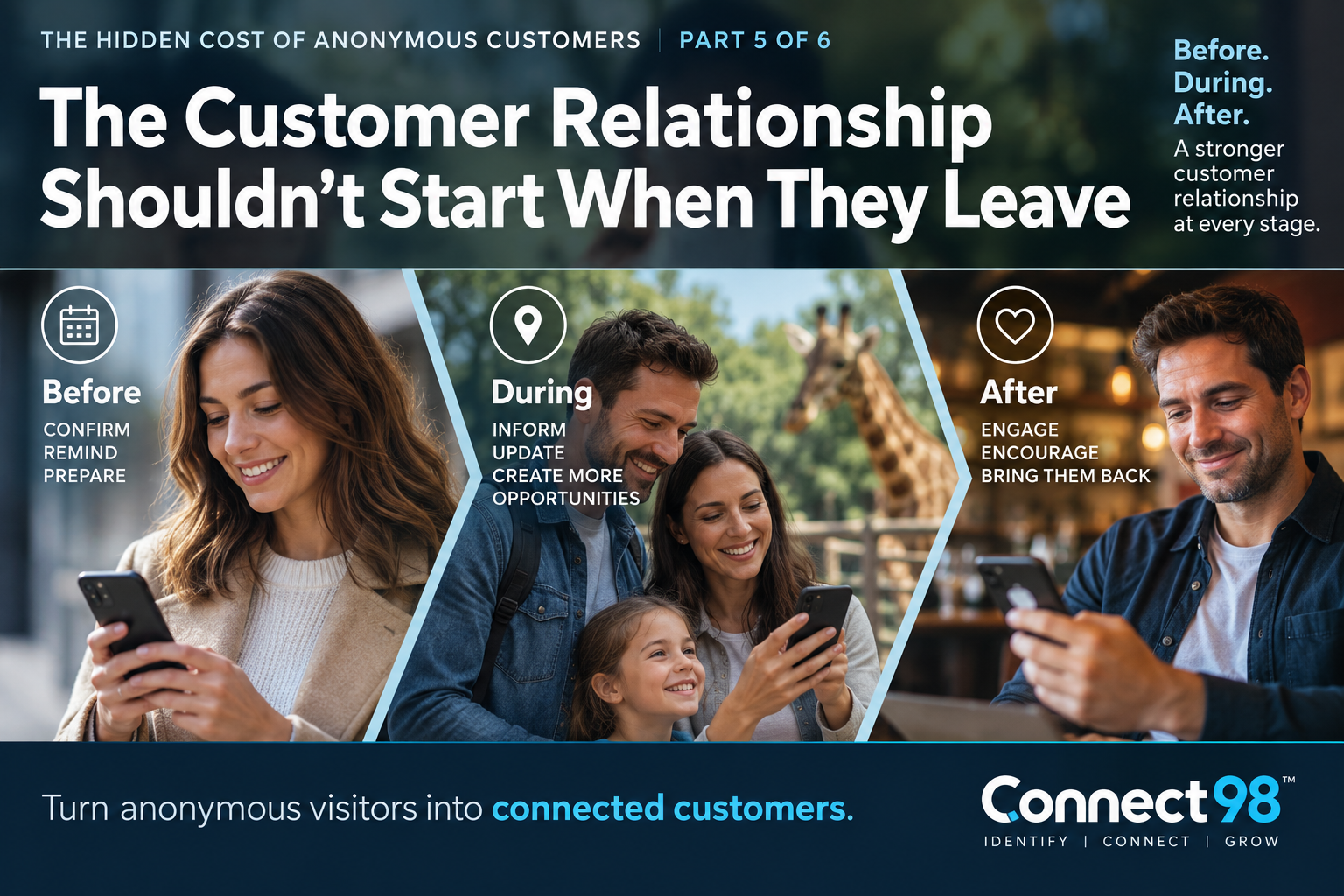
A customer relationship before, during and after the visit
Once a customer has chosen to identify themselves and given the appropriate permission to communicate, the relationship no longer needs to exist at just one point in time. Communication can have a useful role before the experience through confirmations, reminders and relevant information, but it can also continue while the customer is actually there.
During the experience, timely information can help customers get more from their visit and make them aware of opportunities they might otherwise miss. Afterwards, the same direct relationship can be used to encourage another visit, help fill quieter periods or simply keep the business relevant until that customer is ready to return.
That is a very different relationship from simply having the email address or mobile number of the person who happened to make the booking. It also changes the way businesses should think about their customer databases. The objective shouldn’t be to collect as many names and numbers as possible; it should be to create more direct relationships with the people who actually experience the business.
From anonymous visitor to connected customer
Throughout this series, we have looked at the gap between the number of customers a business serves and the number it can actually identify. Closing that gap creates an obvious opportunity for repeat business, but the opportunity is broader when an identified customer can become a connected customer.
That connection gives businesses the ability to communicate at moments when the communication is genuinely useful, whether that’s during today’s visit, when there is an immediate opportunity, or several months later when there is a reason for the customer to return. The value isn’t simply in having another record in a database; it is in having a direct relationship that didn’t previously exist.
Connect98 is designed to help businesses create those relationships without putting unnecessary friction in the customer’s way. Customers can identify themselves using simple methods such as QR codes or branded data-capture screens, while businesses can use SMS to communicate directly with customers who have chosen to hear from them.
The technology itself isn’t really the important part of the argument. The bigger shift is recognising that the customer relationship doesn’t need to begin once the transaction or experience has ended. If the customer has chosen to connect with you, that relationship can begin while the experience is still happening and continue long after they have left.
Next: What Are Anonymous Customers Really Costing You?
Across this series we’ve looked at why so many customers remain anonymous, why booking data doesn’t tell the whole story, how businesses can identify more of the people they serve and what becomes possible once those customers are connected. In the final part, we’ll bring those pieces together and look at the commercial impact of the gap.
Because the cost of an anonymous customer isn’t simply a missing name or mobile number. It can mean future revenue, repeat visits and customer relationships that the business never had the opportunity to create.
Next: Part 6 of 6 — What Are Anonymous Customers Really Costing You?